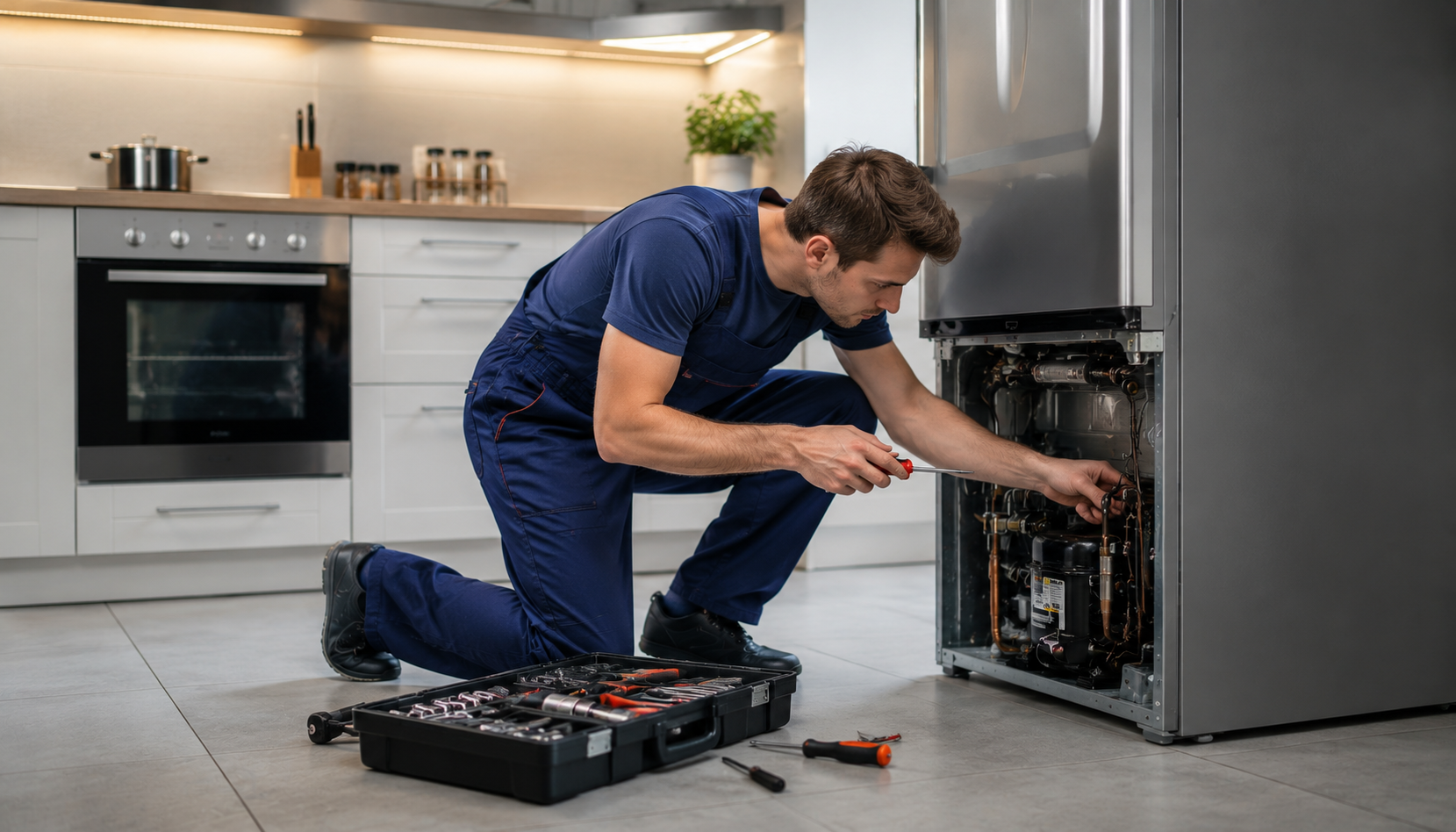
There’s a strange law of household life: the washing machine picks the morning of a job interview to start leaking, and the fridge decides to hum louder right after guests arrive. Anyone who has needed appliance repair services more than once knows this timing isn’t coincidence — it’s wear catching up all at once.
The Slow Buildup Nobody Notices
Most breakdowns don’t happen overnight. A dishwasher that suddenly won’t drain has usually been struggling for weeks, just quietly enough that nobody paid attention. Filters clog a little more each cycle. Belts stretch a fraction of a millimeter every month. A dryer that takes twenty minutes longer than it used to isn’t broken yet — it’s warning you. The problem is that these signs look like nothing on their own. Only in hindsight, once someone calls in appliance repair, does the pattern become obvious.
There’s also a psychological piece to this. People get used to compensating. They learn to jiggle the door handle just right, or run the blender twice because it stalls on thick mixtures. The appliance is failing, but the household adapts around it instead of addressing it — until adapting isn’t possible anymore.
A Different Angle: What Repair Technicians Actually See
Ask anyone who’s spent years doing hands-on repair work, and they’ll tell you the damage rarely matches the complaint. A customer says the oven “just stopped working,” and the technician finds a burnt-out igniter that’s been failing intermittently for a year. Another says the washer is “making weird noises,” and it turns out a coin has been rattling around the drum since the previous owner. The gap between what people notice and what’s actually happening inside the machine is often wide.

This is part of why appliance services exist as a profession rather than a one-size-fits-all fix. Diagnosing a machine isn’t just about replacing the obvious broken part — it’s about understanding how each component interacts with the rest of the system, and how one small failure can quietly stress everything around it.
The Cost of Waiting Versus the Cost of Guessing
There’s a tension every household faces: fix it now, or wait and see if it gets worse. Waiting sometimes works out fine. A slightly noisy fan might run for another two years without issue. But waiting on the wrong kind of problem — a gas smell near a stove, a burning odor from a motor, water pooling near an outlet — turns a manageable repair into a genuinely dangerous situation.
A few signs are usually worth acting on quickly:
- Unusual smells, especially anything electrical or like burning plastic
- Sudden spikes in energy bills with no change in usage
- Repeated tripped breakers when one appliance is running
None of these guarantee a major issue, but they’re the kind of details that are easy to dismiss in the moment and expensive to ignore over time.
It’s Rarely Just About the Machine
What’s easy to forget is that appliances sit inside a whole ecosystem — water pressure, electrical load, even how a kitchen is ventilated. A dishwasher installed in a home with hard water will scale up faster than one running on soft water, regardless of brand or price. A dryer vented through a long, twisting duct will always work harder than one with a short, straight path outside. Sometimes what looks like a faulty unit is really the environment around it pushing the machine past what it was designed for.

That context matters more than people usually assume, and it’s often the missing piece that explains why the same appliance behaves so differently from one home to the next.
At some point, most households end up needing appliance repair services for something — not because the machines are poorly made, but because everything mechanical eventually meets its limits. Understanding what’s actually going on inside these machines, rather than just reacting to the noise or the smell, tends to save both money and stress in the long run.